Water Heater Temperature Setting
There are two right answers, and the reason the advice conflicts is that they solve different problems.
Heat & Tap earns a commission on qualifying purchases made through the Amazon links on this page, at no extra cost to you. Commission does not decide what we recommend or how we rank it. Full disclosure.
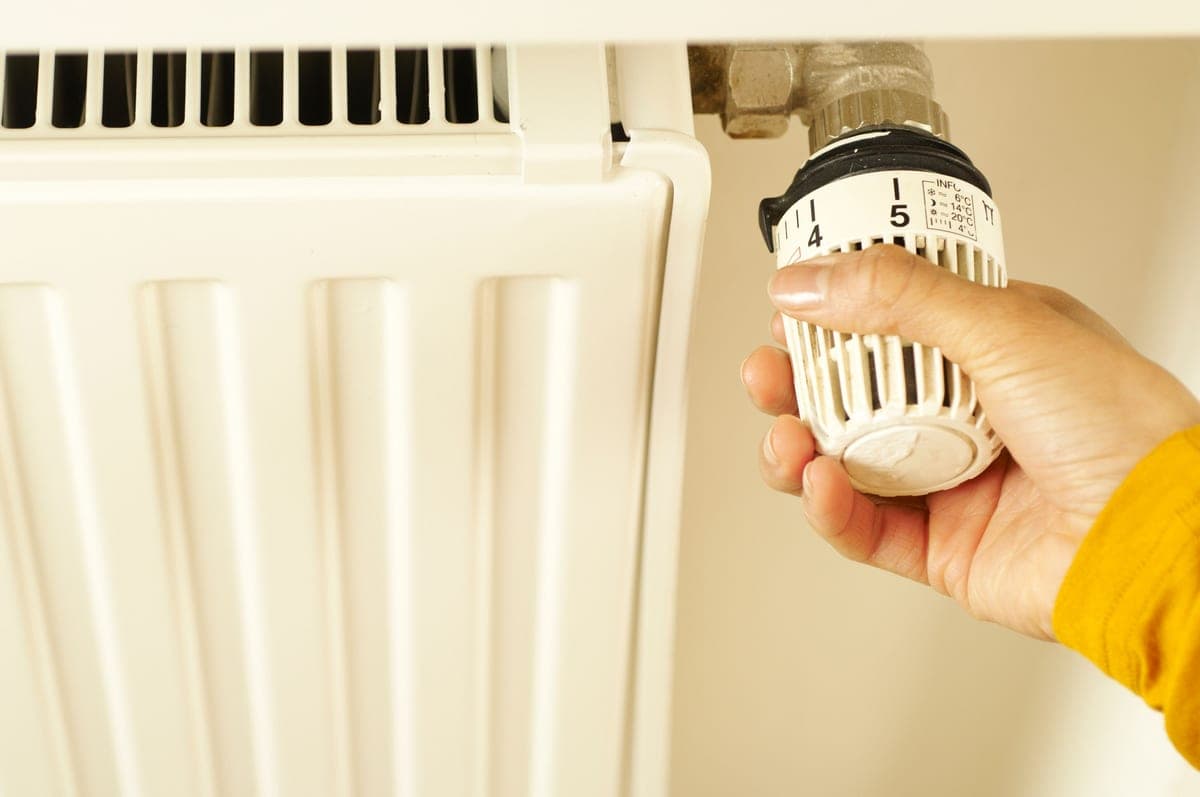
Set the tank to 120°F if you want one setting and no extra hardware. It is the standard scald-safety recommendation and it is kinder to the anode and the tank. Set it to 140°F and fit a thermostatic mixing valve if anyone in the house is immune-compromised, or the tank sits unused for long periods — storing hot and blending down gives you bacteria control at the tank and a safe temperature at the tap. The Honeywell AM-1 is adjustable across 70 to 145°F depending on variant, rated to 150 psi and 212°F.
The reason you will find 120°F and 140°F recommended with equal confidence is that they are answers to different questions. One hundred and twenty degrees is about not scalding anybody. One hundred and forty is about not growing anything. You can have both, but only with a valve in between.
What each setting actually buys you
| Setting | Good for | Bad for |
|---|---|---|
| 120°F | Scald safety, lower standby loss, slower scale formation, longer anode life | Bacteria control in a tank that sits unused; usable hot water volume |
| 130°F | A middle position many manufacturers ship at | Neither problem fully solved |
| 140°F | Bacteria control; more usable hot water from the same tank once blended | Scald risk at the tap without a mixing valve; faster scale; faster anode consumption |
| 140°F + mixing valve | Both — bacteria control in the tank, safe delivery at the fixture | Costs a valve and a fitting, and adds a restriction |
| Above 140°F | Nothing useful in a home | Serious scald hazard, accelerated scale and anode loss |
The third row is why plumbers so often turn tanks up and homeowners so often turn them down. Storing hotter means you can blend more cold into the same draw, so a 40-gallon tank at 140°F delivers more usable showers than the same tank at 120°F. That is a real gain, and without a mixing valve it arrives at the tap as a hazard.
The dial that has letters instead of numbers
Gas tanks frequently have a dial marked something like VACATION, A, B, C, HOT rather than degrees. The letters are not standardised across brands, so there is no table we can give you that converts them honestly. Do it empirically instead.
- Run the hot tap nearest the heater for two minutes to clear the pipe.
- Fill a cup and measure it with a cooking thermometer.
- Adjust the dial by one mark, wait two to three hours for the tank to stabilise, and measure again.
- Repeat until the delivered temperature is where you want it, then mark the dial yourself.
What to look for in a mixing valve
- An adjustable range that covers where you want to deliver. The Honeywell AM-1 is published at 70 to 145°F depending on variant, and 70 to 120°F and 70 to 180°F variants exist.
- A lead-free brass body, with a pressure rating well above your house pressure — the AM-1 is rated to 150 psi and 212°F.
- The connection type you actually need. NPT, union CPVC, union press and PEX variants exist, and picking the wrong one turns a one-hour job into two trips.
- 3/4 inch sizing for a whole-house valve on a standard residential tank.
- A reason to fit it at all. A mixing valve on a tank set at 120°F does almost nothing except add a restriction and a failure point. It earns its place only when the tank is set hot.
Quick picks
Tap any row to read the full assessment below, or go straight to Amazon from the right-hand column. We earn a commission on qualifying purchases at no extra cost to you.
| # | Product | Best for | Price |
|---|---|---|---|
| 1 |  Honeywell AM-1 (AM101) mixing valveThe thermostatic mixing valve that lets you store water at 140°F for bacteria control and still deliver a safe temperature at the tap — adjustable from 70 to 145°F depending on variant. | Storing hot, delivering safe | Check price on Amazon No live price feed on this site, so we show none. #ad |
| 2 | Intermatic WH40 water heater timerThe mechanical 40 A water heater timer: 240 V DPST, 1 to 23 hour settings, up to twelve on and twelve off events a day — the simplest way to keep a resistance tank off during peak rates. | Time-of-use electric rates | Check price on Amazon No live price feed on this site, so we show none. #ad |
| 3 |  Corro-Protec powered anode rodA powered titanium anode that does not deplete, carries a 20-year limited warranty, and is the usual fix for the rotten-egg smell a magnesium rod causes. | Hard water and smelly water | Check price on Amazon No live price feed on this site, so we show none. #ad |
The parts this guide calls for
Pick 1 — Storing hot, delivering safe
Honeywell AM-1 (AM101) mixing valve
The thermostatic mixing valve that lets you store water at 140°F for bacteria control and still deliver a safe temperature at the tap — adjustable from 70 to 145°F depending on variant.
| Size | 3/4 in |
|---|---|
| Body | Brass, lead free |
| Pressure rating | 150 psi |
| Temperature rating | 212°F |
| Adjustable range | 70 - 145°F (variant dependent; 70 - 120°F and 70 - 180°F variants exist) |
| Connections | NPT, union CPVC, union press or PEX depending on variant |
What is good
- Lets you raise the tank set point for Legionella control without scalding anyone
- Also increases usable hot water: hotter storage mixed down goes further
- Multiple connection styles so it suits copper, CPVC, PEX or press
- Anti-scald and anti-chill in one device
What is not
- Several variants share the AM101 prefix with different temperature ranges — order the right one
- It is one more device on the hot outlet that can fail closed
- Needs a union or isolation to be serviceable
Skip it if: Skip it if you are not going to raise the tank temperature. Fitted to a tank set at 120°F it does almost nothing, and it adds a restriction and a failure point for no benefit.
No live price feed on this site, so we show none. #ad
Specifications above from First Supply listing, Honeywell AM101-UCPVC-1LF/U; Granite Group listing, AM101-UP-1LF/U, 70-145F. We have not tested this unit ourselves.
Pick 2 — Time-of-use electric rates
Intermatic WH40 water heater timer
The mechanical 40 A water heater timer: 240 V DPST, 1 to 23 hour settings, up to twelve on and twelve off events a day — the simplest way to keep a resistance tank off during peak rates.
| Rating | 40 A, DPST, 2 poles |
|---|---|
| Voltage | 208 - 277 V AC |
| Load | 10,000 W; 2 hp and 5 hp motor ratings |
| Setting range | 1 - 23 hours; minimum 1 hour on or off |
| Events | Up to 12 on and 12 off per day |
| Enclosure | NEMA 1 |
| Operating temperature | -40 to 130°F |
What is good
- No firmware, no app, no cloud account — a dial and a set of trippers
- Saves real money where electricity is billed by time of use
- NEMA 1 enclosure suits an indoor utility wall
- 40 A covers any residential resistance tank
What is not
- Only useful if your utility actually charges different rates by hour
- A tank held off for hours can run out mid-evening
- NEMA 1 is indoor-only: it needs a different enclosure in a garage exposed to weather
Skip it if: Skip it on a heat pump water heater. Those already run on a schedule you control from the unit, and interrupting the compressor's power on a timer gains nothing while risking short cycling.
No live price feed on this site, so we show none. #ad
Specifications above from Pace Supply listing, Intermatic WH40; Platt listing, Intermatic WH40 24-hour DPST. We have not tested this unit ourselves.
Pick 3 — Hard water and smelly water
Corro-Protec powered anode rod
A powered titanium anode that does not deplete, carries a 20-year limited warranty, and is the usual fix for the rotten-egg smell a magnesium rod causes.
| Type | Powered titanium MMO anode with a low-voltage controller |
|---|---|
| Mechanism | Impressed-current cathodic protection |
| Depletion | Does not deplete, unlike magnesium or aluminum |
| Warranty | 20-year limited, with a 90-day money-back guarantee |
| Certification | Certified lead free by WQA under NSF/ANSI/CAN 372 |
What is good
- It does not sacrifice itself, so it does not need replacing every few years
- Usually eliminates the sulfur smell that a magnesium rod produces in some water
- 20-year warranty against a sacrificial rod's 3 to 18 months in hard water
- Lead-free certified for potable use
What is not
- Needs a power outlet near the heater and a controller mounted somewhere
- Costs several times a sacrificial rod
- No protection at all during a power cut
Skip it if: Skip it if your tank is already more than about eight years old. A powered anode cannot undo corrosion that has already happened, and the money is better spent toward the replacement that is coming anyway.
No live price feed on this site, so we show none. #ad
Specifications above from Corro-Protec product facts; Corro-Protec, magnesium versus aluminum anodes. We have not tested this unit ourselves.
What temperature does to the tank itself
Hotter water precipitates minerals faster and consumes the sacrificial anode faster. Both of those are the tank's life rather than your gas bill, and both are reasons to pair a 140°F setting with better maintenance rather than to avoid it.
- Anode consumption. Magnesium and aluminium rods deplete, and replacement intervals of three to eighteen months are reported in hard water. A powered titanium anode does not deplete at all, which is the usual answer on a hot-stored tank. Water heater anode rods.
- Scale and sediment. More precipitation at the bottom of the tank means more insulation between the burner and the water, and a popping or rumbling noise. Water heater sediment.
- The smell problem. A magnesium rod in water with sulphate-reducing bacteria produces the rotten-egg smell, and raising the temperature does not fix it. A powered anode usually does.
Turning it off instead of turning it down
On an electric resistance tank, a timer is the other half of this decision. The Intermatic WH40 is a 40 A DPST mechanical timer rated for 208 to 277 V and up to 10,000 W, with 1 to 23 hour settings and up to twelve on and twelve off events per day. On a time-of-use tariff, keeping the elements off through the peak window is a larger saving than any thermostat adjustment.
Two cautions. A timer does not help a gas tank, where standby loss is already small relative to the burner's efficiency. And it should not be fitted to a heat pump water heater — those already schedule themselves from the unit's own controls, and interrupting the compressor's power gains nothing while risking short cycling.
The vacation setting on the dial does the same job for a week away without any hardware, and on a gas tank it is the right answer rather than the cheap one.
What goes in with it
A water heater is a system, not a box. These are the parts that go in with it, and the ones people discover they need halfway through the job.
- Expansion tank
Required by code on a closed system, which is most homes with a pressure-reducing valve.
- Drain pan
Cheap insurance anywhere the tank sits above something you care about.
- Anode rod
The part that decides when the tank leaks. Replacing it is the highest-value hour of maintenance there is.