Water Heater Breaker and Wire Size
From a standard wall outlet to 113 amps across three circuits. The published numbers, with the gotchas.
Heat & Tap earns a commission on qualifying purchases made through the Amazon links on this page, at no extra cost to you. Commission does not decide what we recommend or how we rank it. Full disclosure.
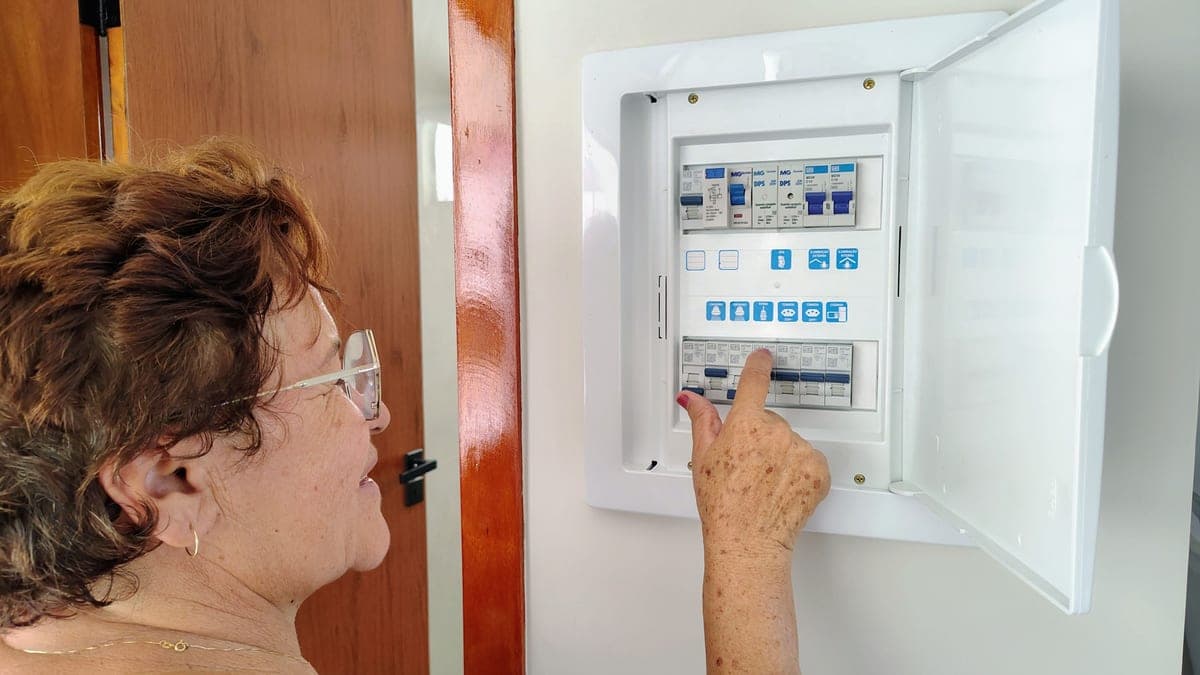
A 120 V mini tank runs on a standard 15 A outlet. A 240 V resistance tank typically needs a 30 A circuit. A heat pump needs 240 V 30 A, or 120 V 15 A on the plug-in version. A whole-house electric tankless unit needs 100 A or more — the Stiebel Eltron Tempra 24 Plus draws 100 A on two 50 A breakers with a 150 A minimum service.
The published requirements
| Unit | Voltage | Output | Breakers | Wire | Draw | Service |
|---|---|---|---|---|---|---|
| Bosch Tronic 3000 T ES4 | 120 V | 1,440 W | Standard 15 A outlet | Existing branch circuit | 12 A | No special requirement |
| Bosch Tronic 3000 T ES8 | 120 V | 1,440 W | Standard 15 A outlet | Existing branch circuit | 12 A | No special requirement |
| Eemax EMT6 | 120 V | 1,440 W | Standard outlet | Existing branch circuit | 12 A | No special requirement |
| Rheem MiniTank 6 | 120 V | Per model | Grounded shared outlet via cord | Existing branch circuit | Per model | No special requirement |
| Rheem ProTerra 120 V plug-in | 120 V | 1.8 kW | Dedicated 15 A | Per manual | Per manual | No special requirement |
| Rheem ProTerra 50 (240 V) | 208 to 240 V | Heat pump + 5,000 W backup | Typically 30 A | Per manual | Per manual | Standard residential |
| Rheem Gladiator 50 | 240 V | 5,500 W double element | Typically 30 A | Per manual | Per manual | Standard residential |
| EcoSmart ECO 11 | 240 V | 13.8 kW | 1 x 60 A double-pole | 6 AWG | 54 A | Not stated |
| Stiebel Eltron Tempra 24 Plus | 240 V (24 kW) / 208 V (18 kW) | 24 kW / 18 kW | 2 x 50 A double-pole | 2 x 6 AWG copper | 100 A | 150 A minimum |
| Rheem RTEX-24 | 240 V | 24 kW | 3 x 40 A | Per manual | 100 A | 200 A stated |
| EcoSmart ECO 27 | 240 V | 27 kW | 3 x 40 A | 3 x 8 AWG | 113 A | Not stated |
Where we have written "per manual" we did not find the figure in the documentation available to us, and we are not going to estimate a conductor size. Those are the cases to get from the installation manual or your electrician.
The three thresholds that matter
Threshold 1: a standard outlet
Mini tanks at 1,440 W on 120 V 15 A need no electrical work at all. Rheem explicitly describes a grounded shared outlet for its MiniTank line. This is why point-of-use units are the cheapest way to fix a distant-fixture problem. Point-of-use water heaters.
Threshold 2: a dedicated 120 V circuit
The Rheem ProTerra 120 V plug-in heat pump is the interesting case here: it specifies a dedicated 120 V 15 A circuit. That is real electrical work, but it is modest work, and it is the only route to heat pump efficiency in a house with no panel capacity for a 240 V circuit. There is a separate shared-circuit variant with its own model number and a different published UEF. 120 V plug-in heat pumps.
Threshold 3: 100 amps and up
This is where whole-house electric tankless lives, and where most projects die. A 100 A or 125 A service cannot absorb 100 to 113 A of additional draw. A service upgrade typically costs more than the entire water heater, which is the honest reason we rarely recommend whole-house electric tankless.
The 208 volt problem
A great many American homes and apartments — especially in multi-family buildings — sit nearer 208 V than 240 V. The consequence on an electric tankless unit is substantial.
| 240 V | 208 V | |
|---|---|---|
| Output | 24 kW | 18 kW |
| Rise at 1.50 GPM | 92°F | 82°F |
| Rise at 2.25 GPM | 73°F | 54°F |
| Rise at 3.00 GPM | 54°F | 41°F |
| Rise at 4.50 GPM | 37°F | 27°F |
Measure your actual supply voltage at the panel before sizing an electric tankless unit, and if it is 208 V, size from the 208 V column. Sizing from the 240 V figures on a 208 V supply gives you a lukewarm shower from a unit working exactly as specified. Tankless sizing chart.
The units at each threshold
Pick 1 — One fixture, or a warm-inlet apartment
EcoSmart ECO 11
A single-fixture electric unit, not a whole-house one: 13.8 kW at 240 V delivering 1.3 to 3.2 GPM depending entirely on how cold your inlet water is.
| Output | 13.8 kW at 240 V; 11 kW at 220 V |
|---|---|
| Flow | 1.3 - 3.2 GPM depending on inlet temperature |
| Breaker | 60 A double-pole |
| Wire | 6 AWG |
| Current draw | 54 A |
| Energy factor | 0.998 |
| Set point | Digital, 1°F increments |
What is good
- One 60 A circuit instead of three, which many existing panels can take
- Honest published flow range tied to inlet temperature
- Small and light enough for a utility closet or under a counter
- Good match for a single shower in a warm-inlet region
What is not
- 3.2 GPM is only reachable with warm inlet water
- Still 54 A — not a plug-in appliance
- No modulation headroom if a second fixture opens
Skip it if: Skip it as a whole-house heater anywhere north of the Sun Belt. At a northern winter inlet temperature it lands at the bottom of its range, which is a hand-wash flow rate, not a shower.
No live price feed on this site, so we show none. #ad
Specifications above from EcoSmart ECO 6 / 8 / 11 specification sheet (PDF). We have not tested this unit ourselves.

Pick 2 — Whole-house electric, warm inlet
Stiebel Eltron Tempra 24 Plus
The electric tankless to buy if you are going to buy one at all: it publishes its full rise-versus-flow curve, and the Advanced Flow Control throttles flow instead of letting the temperature sag.
| Output at 240 V | 24 kW |
|---|---|
| Output at 208 V | 18 kW |
| Breakers | 2 x 50 A double-pole |
| Wire | 2 x 6 AWG copper |
| Current draw | 100 A |
| Minimum electrical service | 150 A |
| Rise at 240 V | 54°F at 3.0 GPM; 73°F at 2.25 GPM; 37°F at 4.5 GPM |
| Rise at 208 V | 41°F at 3.0 GPM; 54°F at 2.25 GPM; 27°F at 4.5 GPM |
| Maximum flow | 8 GPM |
What is good
- Publishes rise at four flow rates on both voltages, which is the only honest way to size an electric tankless
- Advanced Flow Control cuts flow to hold the set temperature rather than delivering lukewarm water
- No venting, no gas line, no condensate
- Small enough to go in the cabinet it replaced
What is not
- 100 A of draw and a 150 A minimum service rules out a lot of older houses
- At 208 V it loses a quarter of its output, and plenty of homes are nearer 208 than 240
- Running cost follows the electric rate, which is usually worse than gas per BTU
Skip it if: Skip it if your inlet water drops to 45°F in winter and you want two showers at once. At a 73°F rise it delivers 2.25 GPM — one shower, nothing else. Cold-inlet climates are where electric tankless disappoints people.
No live price feed on this site, so we show none. #ad
Specifications above from Stiebel Eltron Tempra Plus technical specifications (PDF); Stiebel Eltron Tempra Plus submittal sheet (PDF). We have not tested this unit ourselves.
Pick 3 — No 240 V circuit available
Rheem ProTerra 120 V plug-in, 50 gal
The one heat pump water heater that does not need an electrician: it runs on a dedicated 120 V 15 A circuit, which makes it the only realistic efficiency upgrade in a condo or a house with a full panel.
| Capacity | 50 gallons |
|---|---|
| Voltage | 120 V |
| Power | 1.8 kW |
| Circuit | Dedicated 120 V 15 A |
| Efficiency | 3.0 UEF on a dedicated circuit; up to 3.5 UEF on the shared-circuit model |
| Ambient operating range | 37 - 145°F |
| Cold-climate rating | Designed to meet NEEA Northern Climate Specification Tier 2 |
| Utility programs | Built-in EcoPort CTA-2045 port |
What is good
- A standard 120 V circuit removes the panel upgrade that kills most heat pump retrofits
- Still roughly three times as efficient as a resistance tank
- CTA-2045 port makes it eligible for utility demand-response payments where those exist
- Same 37°F lower operating limit as the 240 V models
What is not
- 1.8 kW means slow recovery — this is a tank you let work overnight, not one you push
- No big resistance element to bail you out during a surge in demand
- A dedicated circuit is still a circuit: a shared-outlet install is a different model number
Skip it if: Skip it if your household regularly empties the tank — a big family, or two showers plus a dishwasher back to back. With 1.8 kW of input and no large backup element, recovery is the whole constraint.
No live price feed on this site, so we show none. #ad
Specifications above from Rheem plug-in heat pump specification sheet (PDF); Ferguson listing, ProTerra 50 gal 120 V plug-in. We have not tested this unit ourselves.
What to ask an electrician
- What is my service size, and what is my calculated load? The nameplate on the panel plus a load calculation. This is the number that decides feasibility.
- Is my supply closer to 208 V or 240 V? Takes thirty seconds with a meter and changes the sizing.
- How many spare double-pole positions do I have? Three 40 A breakers is three positions, not one.
- What would a service upgrade cost? Worth knowing even if you then decide against it, because it reframes the whole comparison.
- For a heat pump: is the existing water heater circuit adequate? Usually yes for a 240 V model, which is a large part of why heat pump retrofits are feasible where tankless ones are not.
What goes in with it
A water heater is a system, not a box. These are the parts that go in with it, and the ones people discover they need halfway through the job.
- Expansion tank
Required by code on a closed system, which is most homes with a pressure-reducing valve.
- Drain pan
Cheap insurance anywhere the tank sits above something you care about.
- Anode rod
The part that decides when the tank leaks. Replacing it is the highest-value hour of maintenance there is.