Mini Tank vs Tankless Water Heater
For the sink at the far end of the house, the deciding factor is the circuit, not the technology.
Heat & Tap earns a commission on qualifying purchases made through the Amazon links on this page, at no extra cost to you. Commission does not decide what we recommend or how we rank it. Full disclosure.
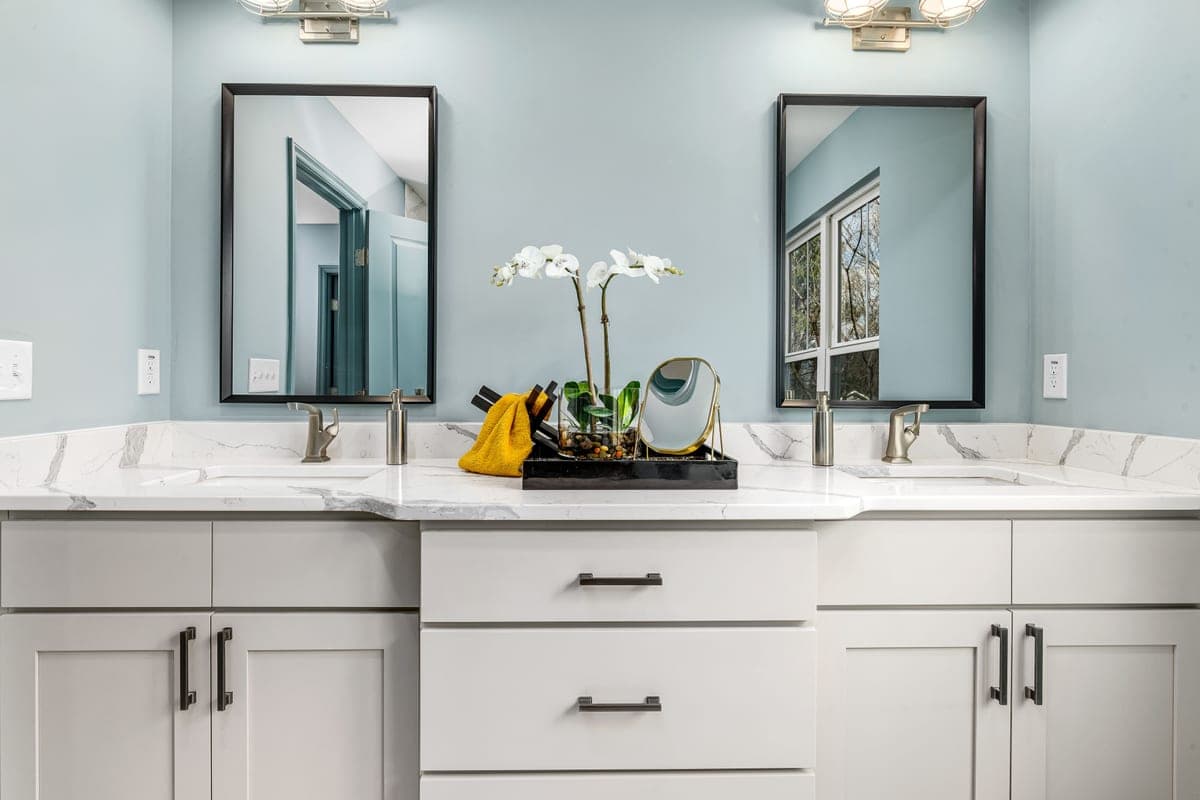
For a single sink, buy the mini tank. A 4-gallon Bosch Tronic 3000 T ES4 runs on a standard 120 V 15 A outlet at 1,440 W and needs no electrician. A point-of-use tankless like the EcoSmart ECO 11 wants a 60 A double-pole breaker and 6 AWG wire — 54 A of draw to serve one faucet. The tankless only wins when the draw is continuous, because a mini tank runs out and then recovers slowly.
This is the one comparison on the site where the small, old-fashioned technology wins most of the time. A mini tank is a thermos with a 1,440 W element in it. A point-of-use tankless is a 13.8 kW appliance. For hand washing at a remote sink, the thermos is correct and the 13.8 kW appliance is an electrical project.
Side by side on published figures
| Bosch ES4 | Rheem MiniTank 6 | Bosch ES8 | EcoSmart ECO 11 | |
|---|---|---|---|---|
| Type | Mini tank | Mini tank | Mini tank | Tankless |
| Capacity | 4 gallons | 6 gallons | 7.1 gallons | None — heats on demand |
| Voltage | 120 V | 120 V | 120 V | 240 V |
| Power | 1,440 W | Not published | 1,440 W | 13.8 kW |
| Circuit | Standard 15 A outlet | Shared grounded outlet via cord | Standard 15 A outlet | 60 A double-pole |
| Wire | Cord | Cord | Cord | 6 AWG |
| Current | 12 A | Not published | Not published | 54 A |
| Output per draw | 4 gallons then recovery | 6 gallons then recovery | Up to 7.1 gallons per draw cycle | Continuous, 1.3 – 3.2 GPM by inlet temp |
| Efficiency | 98% thermal | Not published | Not published | 0.998 energy factor |
| Mounting | Floor or wall, bracket included | Floor or wall, bracket included | Wall or floor | Wall |
| Warranty | Not published | 5-year leaks, 2-year parts | Not published | Not published |
The row that settles it is the circuit row. Three of these four plug in. The fourth needs a dedicated 60 A double-pole breaker, 6 AWG copper and an electrician, to serve a fixture that a 12 A appliance already serves.
Quick picks
Tap any row to read the full assessment below, or go straight to Amazon from the right-hand column. We earn a commission on qualifying purchases at no extra cost to you.
| # | Product | Best for | Price |
|---|---|---|---|
| 1 | Bosch Tronic 3000 T ES4 (4 gal)Four gallons on a standard wall outlet: the simplest fix for the bathroom at the far end of the house where hot water takes 90 seconds to arrive. | A single far-away sink | Check price on Amazon No live price feed on this site, so we show none. #ad |
| 2 |  Rheem Professional Classic MiniTank, 6 galSix gallons on a shared 120 V outlet from a brand with real warranty support: five years on leaks, two on parts, and four capacities in the same family if six is the wrong number. | Wall-mounted point of use | Check price on Amazon No live price feed on this site, so we show none. #ad |
| 3 |  Bosch Tronic 3000 T ES8 (7.1 gal)The larger mini tank: 7.1 gallons delivered per draw cycle on an ordinary 15 A outlet, which stretches the category from one faucet to a small bathroom. | A sink plus a small basin | Check price on Amazon No live price feed on this site, so we show none. #ad |
| 4 | EcoSmart ECO 11A single-fixture electric unit, not a whole-house one: 13.8 kW at 240 V delivering 1.3 to 3.2 GPM depending entirely on how cold your inlet water is. | One fixture, or a warm-inlet apartment | Check price on Amazon No live price feed on this site, so we show none. #ad |
The four units in full
Pick 1 — A single far-away sink
Bosch Tronic 3000 T ES4 (4 gal)
Four gallons on a standard wall outlet: the simplest fix for the bathroom at the far end of the house where hot water takes 90 seconds to arrive.
| Capacity | 4 gallons |
|---|---|
| Voltage | 120 V |
| Power | 1,440 W |
| Current | 12 A |
| Circuit | Standard 120 V 15 A outlet |
| Tank | Glass-lined with CFC-free foam insulation |
| Mounting | Floor or wall, bracket included |
| Thermal efficiency | 98% |
What is good
- Plugs into an existing outlet — no electrician, no permit, no panel work
- Front-mounted temperature knob rather than a hidden thermostat
- Wall or floor mounting makes it fit a vanity cabinet or a utility corner
- Eliminates the long wait and the water wasted waiting
What is not
- Four gallons is one sink, not one shower
- 1,440 W recovery means you notice the limit if you drain it
- Still a standby load, albeit a small one
Skip it if: Skip it if you want this to feed a shower. Four gallons at 1,440 W will produce a warm rinse and then cold water — the mini-tank category is for hand washing and dishes.
No live price feed on this site, so we show none. #ad
Specifications above from Rural Energy listing, Bosch Tronic 3000T; Walmart listing, Bosch ES4 Tronic 3000 T. We have not tested this unit ourselves.
Pick 2 — Wall-mounted point of use
Rheem Professional Classic MiniTank, 6 gal
Six gallons on a shared 120 V outlet from a brand with real warranty support: five years on leaks, two on parts, and four capacities in the same family if six is the wrong number.
| Capacities available | 1.5, 2.5, 4.0 and 6.0 gallons |
|---|---|
| Voltage | 120 V, grounded shared outlet via power cord |
| Mounting | Floor or wall, bracket included |
| Footprint | Up to 93% smaller than a standard electric tank |
| Warranty | 5-year leaks, 2-year parts |
What is good
- A published leak warranty, which most mini tanks do not carry
- Four capacities in one family, so you can size to the fixture
- Shared outlet means it can share a circuit with the disposal
- Wall mounting frees the cabinet floor
What is not
- Rheem does not publish a first-hour rating for the MiniTank line
- Six gallons is still a point-of-use volume
- Cord-and-plug connection limits where it can legally go in some jurisdictions
Skip it if: Skip it if the outlet under your sink is on a GFCI circuit shared with a garbage disposal that trips. A mini tank that loses power silently is a tank of cold water you only discover at the faucet.
No live price feed on this site, so we show none. #ad
Specifications above from Rheem Professional Classic MiniTank product page. We have not tested this unit ourselves.
Pick 3 — A sink plus a small basin
Bosch Tronic 3000 T ES8 (7.1 gal)
The larger mini tank: 7.1 gallons delivered per draw cycle on an ordinary 15 A outlet, which stretches the category from one faucet to a small bathroom.
| Capacity | 7.1 gallons |
|---|---|
| Voltage | 120 V |
| Power | 1,440 W |
| Circuit | Standard 120 V 15 A outlet |
| Delivery | Up to 7.1 gallons per draw cycle before recovery |
| Tank | Glass-lined, foam insulated |
What is good
- Nearly double the ES4's storage on the same 15 A outlet
- 7.1 gallons covers washing up plus a basin without recovering
- No wiring work needed
- Same simple serviceable design as the smaller unit
What is not
- Takes more cabinet space than the 4-gallon version
- Same 1,440 W recovery, so it refills no faster — it just holds more
- Larger standby loss than the ES4
Skip it if: Skip it if the cabinet under the sink is shallow. The ES8 is noticeably bigger than the ES4, and a mini tank that does not fit the cabinet ends up on the floor beside it.
No live price feed on this site, so we show none. #ad
Specifications above from Rural Energy listing, Bosch Tronic 3000T ES8. We have not tested this unit ourselves.
Pick 4 — One fixture, or a warm-inlet apartment
EcoSmart ECO 11
A single-fixture electric unit, not a whole-house one: 13.8 kW at 240 V delivering 1.3 to 3.2 GPM depending entirely on how cold your inlet water is.
| Output | 13.8 kW at 240 V; 11 kW at 220 V |
|---|---|
| Flow | 1.3 - 3.2 GPM depending on inlet temperature |
| Breaker | 60 A double-pole |
| Wire | 6 AWG |
| Current draw | 54 A |
| Energy factor | 0.998 |
| Set point | Digital, 1°F increments |
What is good
- One 60 A circuit instead of three, which many existing panels can take
- Honest published flow range tied to inlet temperature
- Small and light enough for a utility closet or under a counter
- Good match for a single shower in a warm-inlet region
What is not
- 3.2 GPM is only reachable with warm inlet water
- Still 54 A — not a plug-in appliance
- No modulation headroom if a second fixture opens
Skip it if: Skip it as a whole-house heater anywhere north of the Sun Belt. At a northern winter inlet temperature it lands at the bottom of its range, which is a hand-wash flow rate, not a shower.
No live price feed on this site, so we show none. #ad
Specifications above from EcoSmart ECO 6 / 8 / 11 specification sheet (PDF). We have not tested this unit ourselves.
Where the mini tank wins
- No electrical work. A standard 120 V 15 A outlet under the sink is all the ES4 and the ES8 need, and the Rheem MiniTank runs from a grounded shared outlet via its own cord.
- Instant hot at the tap. The water is already hot and already next to the fixture, so the wait is a second or two rather than the 90 seconds a long pipe run costs you.
- It cannot be undersized by cold weather. A tank does not care about inlet temperature the way a tankless unit does; it just reheats more slowly.
- Cheaper to buy and far cheaper to install, which for a single remote sink is most of the total cost.
- A real warranty on the Rheem — five years on leaks and two on parts, with 1.5, 2.5, 4.0 and 6.0 gallon versions if six is the wrong number.
Where the point-of-use tankless wins
- It never runs out. A 4-gallon tank serving a filling sink will deliver four gallons and then cold water; the ECO 11 delivers 1.3 to 3.2 GPM for as long as the tap is open.
- No standby loss, because there is nothing being kept hot between draws.
- No tank to leak, which matters inside a cabinet where a slow leak goes unnoticed for months.
- A smaller footprint in the cabinet itself, if cabinet depth is the binding constraint.
- Set point control in 1°F increments, which a mini tank does not offer.
What to buy for which situation
| Your situation | Pick | Why |
|---|---|---|
| One bathroom sink at the far end of the house | Bosch Tronic 3000 T ES4 | 4 gallons on a wall outlet, 98% thermal efficiency, no electrician |
| A sink plus a small basin or a bidet | Bosch Tronic 3000 T ES8 | Up to 7.1 gallons per draw cycle on the same 15 A outlet |
| Want a stated warranty and a choice of capacities | Rheem Professional Classic MiniTank 6 | Five years on leaks, two on parts, four capacities in the family |
| A long continuous draw — utility sink, dish station | EcoSmart ECO 11 | Continuous flow; a mini tank runs out and then recovers slowly |
| Warm inlet water and no 240 V nearby | A mini tank | The tankless advantage disappears if you cannot feed it 54 A |
| You are really trying to serve a shower | Neither — a whole-house unit | Point-of-use is a hand-washing category, not a bathing one |
The third option most people miss
If the problem is the wait rather than the capacity, a recirculation pump at the main heater fixes every far fixture at once instead of one at a time, and the modern versions do it without a dedicated return line. That is frequently the cheaper answer in a house with two or three slow taps. Hot water recirculating pump without a return line.
If you are weighing a point-of-use unit against simply replacing the main heater, read point-of-use water heaters for the category overview and mini tank water heaters for the full capacity range.
What goes in with it
A water heater is a system, not a box. These are the parts that go in with it, and the ones people discover they need halfway through the job.
- Leak detector
A mini tank lives in a cabinet, which is exactly where a slow leak goes unnoticed for months.
- Anode rod
Mini tanks have one too, and in hard water it is what decides how long the unit lasts.